
The Radium Girls' undying fight for labor rights
Litigation
In Orange, New Jersey, the story of the abuse perpetrated against the workers is distinguished from most such cases by the fact that the ensuing litigation was covered widely by the media. Plant worker Grace Fryer decided to sue, but it took two years for her to find a lawyer willing to take on U.S. Radium. Even after the women found a lawyer, the litigation process moved slowly. At their first appearance in court in January 1928, two women were bedridden and none of them could raise their arms to take an oath. A total of five factory workers – Grace Fryer, Edna Hussman, Katherine Schaub, and sisters Quinta McDonald and Albina Larice – dubbed the Radium Girls, joined the suit.[16] The litigation and media sensation surrounding the case established legal precedents and triggered the enactment of regulations governing labor safety standards, including a baseline of "provable suffering".
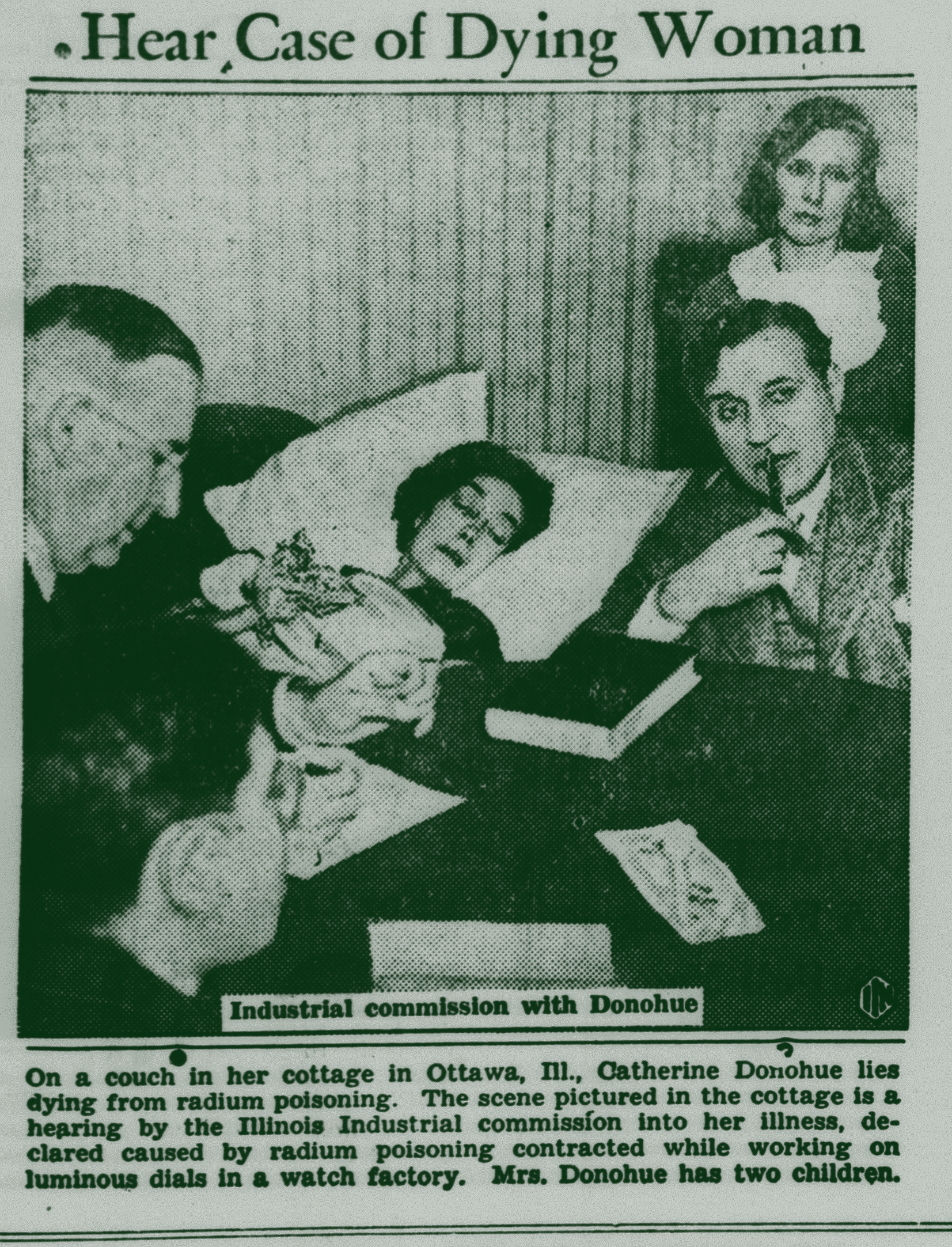
In Illinois, employees began asking for compensation for their medical and dental bills as early as 1927 but were refused by management. The demand for money by sick and dying former employees continued into the mid-1930s before a suit was brought before the Illinois Industrial Commission (IIC). In 1937 five women found an attorney by the name of Leonard Grossman, who would represent them in front of the commission, but by this time, Radium Dial had closed, moving to New York. The IIC did retain a $10,000 deposit left by Radium Dial when it disclosed to the IIC that they could not find any insurance to cover the cost of indemnifying the company against employee suits. In the spring of 1938, the IIC ruled in favor of the women. The attorney representing the interests of Radium Dial appealed hoping to get the verdict overturned, and again the commission judge, George B. Marvel, found for the women. Radium Dial appealed over and over, taking the case all the way to the Supreme Court and on October 23, 1939, the court decided not to hear the appeal and the lower ruling was upheld. In the end, this case had been won eight times before Radium Dial was finally forced to pay.
Historical Impact
The Radium Girls' saga holds an important place in the history of both the field of health physics and the labor rights movement. The right of individual workers to sue for damages from corporations due to labor abuse was established as a result of the Radium Girls case. In the wake of the case, industrial safety standards were demonstrably enhanced for many decades.
The case was settled in the autumn of 1928, before the trial was deliberated by the jury, and the settlement for each of the Radium Girls was $10,000 (equivalent to $158,000 in 2021) and a $600 per year annuity (equivalent to $9,500 in 2021) paid $12 a week (equivalent to $200 in 2021) for all of their lives while they lived, and all medical and legal expenses incurred would also be paid by the company.
The lawsuit and resulting publicity was a factor in the establishment of occupational disease labor law. Radium dial painters were instructed in proper safety precautions and provided with protective gear; in particular, they no longer shaped paint brushes by lip and avoided ingesting or breathing the paint. Radium paint was still used in dials as late as the 1970s
Scientific Impact
Robley D. Evans made the first measurements of exhaled radon and radium excretion from a former dial painter in 1933. At MIT he gathered dependable body content measurements from 27 dial painters. This information was used in 1941 by the National Bureau of Standards to establish the tolerance level for radium of 0.1 μCi (3.7 kBq).
The Center for Human Radiobiology was established at Argonne National Laboratory in 1968. The primary purpose of the center was providing medical examinations for living dial painters. The project also focused on the collection of information and, in some cases, tissue samples from the radium dial painters. When the project ended in 1993, detailed information of 2,403 cases had been collected. This led to a book on the effects of radium on humans. The book suggests that radium-228 exposure is more harmful to health than exposure to radium-226. Radium-228 is more able to cause cancer of the bone as the shorter half life of the radon-220 product compared to radon-222 causes the daughter nuclides of radium-228 to deliver a greater dose of alpha radiation to the bones. It also considers the induction of a range of different forms of cancer as a result of internal exposure to radium and its daughter nuclides. The book used data from radium dial painters, people who were exposed as a result of the use of radium-containing medical products, and other groups of people who had been exposed to radium.